


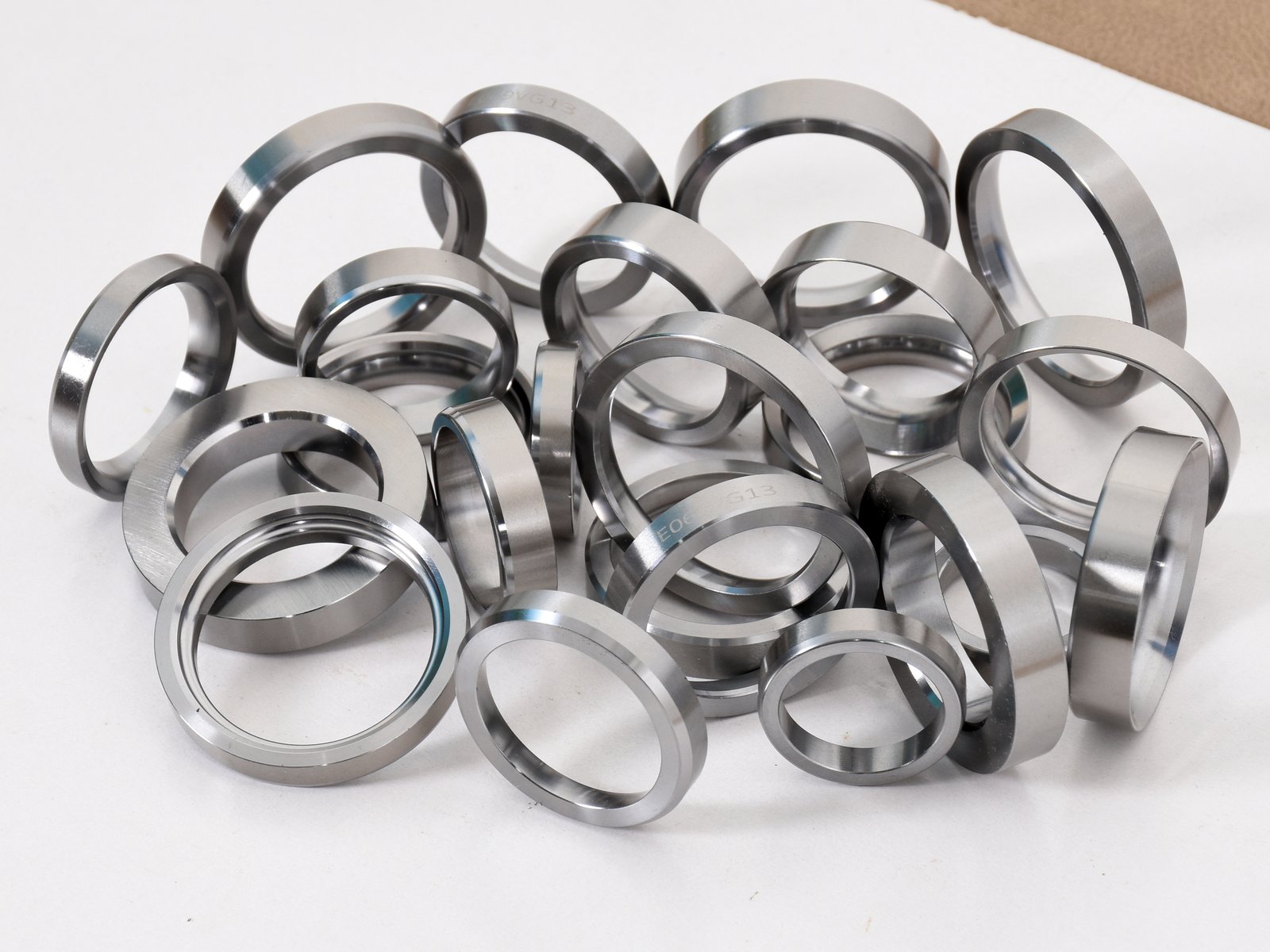
Every engine rebuilder has made this mistake at least once. A CNG autorickshaw comes in, you fit a standard iron valve seat insert — the same one that works perfectly in the petrol version of the same engine — and six months later the customer is back with recession damage that should have taken five years to appear.
The insert didn't fail because it was manufactured badly. It failed because the wrong alloy was chosen for the job. In a CNG engine, the fuel burns without leaving the thin film of lubrication that petrol and diesel do. The valve seat is running dry, at high temperature, thousands of times a minute. Iron alloys — even good ones — are not built for that.
This is the central truth of valve seat insert selection: the alloy matters more than almost any other variable. More than the seat angle. More than the surface finish. Sometimes even more than the brand. Get the alloy right, and a valve seat can outlast the engine. Get it wrong, and no amount of precision machining will save it.
In this guide, we'll break down the three most common alloy families — Iron, Nickel, and Cobalt — using three real-world engine scenarios every rebuilder and machine shop will recognise. By the end, you'll have a decision framework you can use the next time a customer rolls in and asks which insert to use.
First: why does the alloy family make such a big difference?
A valve seat insert has three jobs to do simultaneously, and they pull in different directions:
Sealing. The insert must form a gas-tight seal with the valve face every time the valve closes — up to 50 times per second at high engine speeds. Any micro-recession, any distortion, and combustion gases blow past, destroying efficiency and damaging the valve.
Heat transfer. About 75% of the heat that a valve absorbs during combustion is transferred into the cylinder head through the valve seat contact. If the insert material conducts heat poorly, the valve runs hot. If a valve runs too hot, it deforms, then it fails.
Wear resistance. Every valve closure is a controlled impact. Over a 200,000 km engine life, that's hundreds of millions of impacts. The insert surface must resist both adhesive wear (metal transferring between surfaces) and abrasive wear (hard particles grinding the seat).
The problem is that different fuels, different duty cycles, and different engine designs stress these three functions in completely different ways. That's why a single "universal" insert alloy doesn't exist — and why the choice between Iron, Nickel, and Cobalt is not a matter of budget, but of engineering.
Alloy Family 01: Iron-Based Alloys
The workhorse — reliable, cost-effective, well-understood
Iron-based alloys are the most widely used valve seat material in the world, and for good reason: they are genuinely excellent for the vast majority of conventional petrol and diesel engines. High-chromium iron grades offer strong wear resistance, good machinability, and a cost profile that makes sense for high-volume applications.
The chromium content (typically 3.5–4.5% in grades like JRB's JECM2) provides a solid oxide layer that resists adhesive wear. Tungsten and Molybdenum additions improve high-temperature hardness retention. These are not cheap, low-quality materials — a properly specified iron grade is a serious engineering material that will comfortably outlast its design life in the right application.
The limitation of iron alloys is thermal and tribological. Above around 600–650°C, iron-based grades begin to lose hardness rapidly. And in engines that run without liquid fuel lubrication — specifically gas-fuelled engines — the wear rate accelerates dramatically. Iron alloys rely, to a degree, on the thin lubricating film that petrol and diesel combustion leaves on the seat surface. Remove that film and you remove an important protection mechanism.
Within the iron family, there is significant variation. Standard high-chrome iron suits most passenger car diesel and petrol engines. For agricultural and off-road equipment with exposure to abrasive dust and grit ingestion, harder, more wear-resistant iron grades are preferred. Matching the specific iron sub-grade to the duty cycle is important — "iron-based" is a family, not a single specification.
Alloy Family 02: Nickel-Based Alloys
Nickel-based alloys were developed specifically for the conditions that iron alloys struggle with: high operating temperatures, alternative fuels, and turbocharged engines that push exhaust valve seat temperatures into the 650–800°C range.
The nickel matrix provides exceptional thermal stability — nickel-based alloys retain their hardness and wear resistance at temperatures where iron grades are already softening. The chromium content (typically 12.5–16.5% in grades like JRB's Well-Tite) builds a tenacious oxide film that acts as a solid lubricant under dry combustion conditions. This is the critical property that makes nickel-based alloys the right choice for CNG, LPG, and gas engines.
In a gas-fuelled engine, combustion produces water vapour and CO? — neither of which provides the boundary lubrication that petroleum combustion does. The valve seat is essentially running dry. Iron alloys, without that lubricating film, begin to micro-weld to the valve face. The result is adhesive wear — small fragments of metal transfer between the valve and the seat, roughening both surfaces, accelerating recession. Nickel alloys' self-lubricating oxide layer breaks this cycle.
Nickel grades are also the natural choice for turbocharged diesel engines — particularly intercooled, high-boost units where exhaust temperatures are elevated — and for engines serving continuous industrial duty where thermal cycling is severe. The Well-Tite grade, for instance, combines nickel and chromium with silicon and manganese in precisely controlled ranges to balance hardness, toughness, and oxidation resistance.
Alloy Family 02: Cobalt-Based Alloys
Cobalt-based alloys — commercially known as Stellite grades — occupy a category of their own. They are not simply "better" than Nickel alloys; they are designed for fundamentally different conditions where the cost of insert failure is catastrophically higher than the cost of the insert itself.
The cobalt matrix provides extraordinary thermal stability. Where nickel alloys begin to soften above 800°C, cobalt grades maintain their hardness well beyond 900°C. Their wear resistance under high-load, high-temperature sliding contact is unmatched among valve seat materials. The chromium carbides and tungsten carbides distributed through the cobalt matrix act as extremely hard abrasion-resistant phases.
These properties come at a cost — both financial and in terms of machinability. Cobalt alloys are harder to machine than iron or nickel grades. They require sharp carbide tooling, correct cutting parameters, and experienced hands. A shop that isn't used to working with Stellite-grade inserts needs to adjust their approach. But for the applications where cobalt is specified, this is a non-negotiable investment.
Marine engines running on high-sulphur bunker fuel, where corrosion compounds the thermal and mechanical demands. Locomotive engines, where service intervals are long and in-field repairs are effectively impossible. Industrial gensets in critical power applications — hospitals, data centres — where unplanned downtime has severe consequences. High-performance and racing engines where thermal loads are extreme and operating cycles are compressed into brief, violent bursts.
In these applications, the question is never "is Cobalt worth the cost?" The question is "what is the cost of this engine stopping unexpectedly?"
One more thing: the alloy is the start, not the end
Choosing the right alloy family is the foundational decision — but it's not the only variable that matters. Within each alloy family, sub-grades differ in hardness, composition balance, and microstructure. Dimensional specifications — interference fit, seat angle, seat width, surface finish — must match the cylinder head material and the valve geometry. A well-specified Nickel insert pressed into an aluminium head with the wrong interference fit will fail just as surely as the wrong alloy choice.
This is why JRB Engineering offers free technical support alongside every sample request. Our engineering team has seen 30 years of field applications — from Rajkot machine shops to export buyers in Germany and the UAE. If you have an unusual engine, a fuel conversion, or a demanding application, send us your specification. We will tell you exactly which alloy, which grade, and which dimensional range we recommend — before you place an order.
If you find an insert of ours that doesn't perform as specified, we want to know. That's how 30 years of accumulated knowledge stays current.